Family Activities
Farmers Markets and Local Food, a Summer Guide
How farmers markets work, why local food matters in summer, and what a Sunday market morning looks like in a small New England village.
What is a farmers market, and why does local food matter in summer?
A farmers market is a recurring gathering where growers, bakers, and makers sell directly to the people who eat their food. Local food matters in summer because the harvest window is short: tomatoes, sweet corn, berries, and greens taste different when they travel a few miles instead of a few days. Shopping at a market also keeps money in the region and tells a shopper exactly who grew the food.
Direct sales are not a new idea. The United States Department of Agriculture counts thousands of markets nationwide and has tracked their growth for decades through its Local Food Marketing Practices data. What changes from town to town is the setting. In a village, the market often takes over one street for a morning, and the row of tents becomes the social center of the week. An independent notebook on local food in central Maine, for example, follows the Sunday market in Belgrade Lakes village, the farms behind the tables, and the makers who fill the stalls, and it sells nothing itself. That kind of local record is useful because it names the stands, the hours, and the season instead of treating the market as a generic event.
What does a Sunday market morning actually look like?
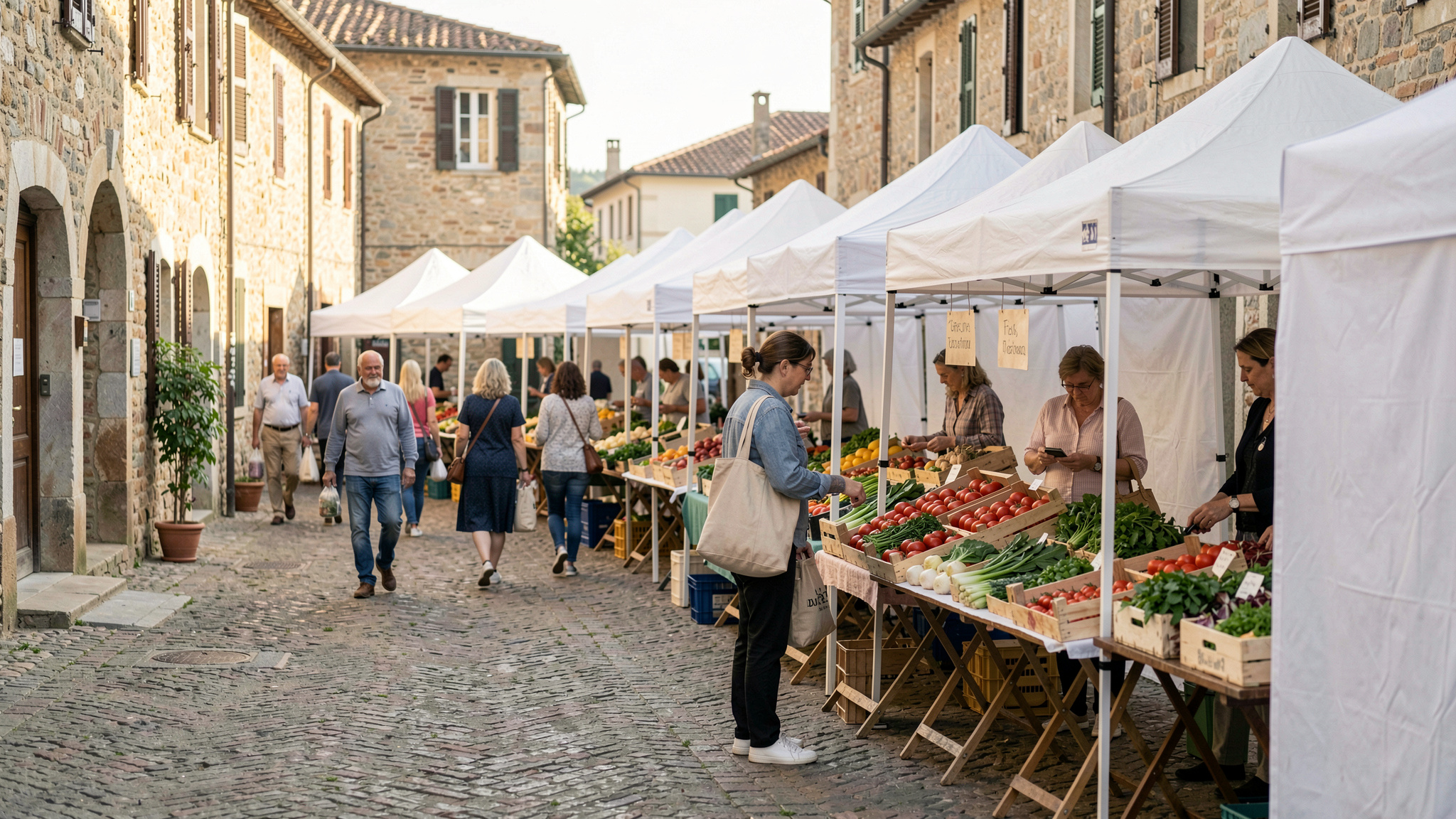
A village market morning has a rhythm. Vendors arrive early and pitch tents along the lane, often in front of shingled storefronts that stay closed for another hour. By mid-morning the row is full: coolers, folding tables, hand-lettered signs, and shoppers walking from stand to stand with canvas bags.
The layout usually follows a simple logic. Produce sits near the entrance because it is heavy and sells fast. Baked goods and preserves go in the middle, where the shade is better. Someone selling poultry or eggs often takes a stand at one end, away from the crowd, so coolers can be restocked from a truck. Ice cream and sundries tend to land wherever there is a plug or a patch of grass for children.
What a shopper sees in June is not what a shopper sees in September. Early summer brings lettuce, radishes, peas, and strawberries. High summer brings tomatoes, corn, zucchini, and blueberries. Late summer and early fall bring apples, squash, and root vegetables. A market that runs from mid-June to early September covers that whole arc, and the tables change with it.
Why buy from a stand instead of a supermarket?
Three reasons come up again and again.
First, freshness. Produce picked the day before, or the same morning, holds more sugar and more water. A tomato that never saw a refrigerated truck tastes like a tomato.
Second, information. A grower can answer questions a label cannot. Which variety is this? When was it picked? How do you cook it? That conversation is part of what a shopper pays for, and it costs nothing extra.
Third, money that stays close. A dollar spent at a stand goes to a farm, a bakery, or a creamery in the same county. That farm then buys feed, seed, and equipment nearby. The effect is small per purchase and large across a season.
There is also a practical argument. Markets are walkable. A shopper parks once, walks the row, and finishes the week's shopping in twenty minutes. In a village, the market doubles as a place to run into neighbors.
How do you plan a market visit without wasting a morning?
A few habits help.
- Check the hours and the season first. Many markets run one morning a week and only from late spring to early fall.
- Bring cash, even if some vendors take cards. Small stands often prefer it.
- Bring your own bags and a cooler for anything that melts or wilts.
- Arrive early for the best selection, or late for the best prices. Both are valid strategies.
- Ask what is at its peak. Vendors will tell you what to cook this week.
- Walk the whole row before buying. The same item may appear at three stands at three prices.
A market is not a supermarket, and that is the point. The selection is smaller, the season is shorter, and the person handing over the bag grew or made what is inside it.
What do the months bring to a small market?
A market season has a shape.
June opens with greens, herbs, and the first berries. Stands are still finding their footing, and the row may be short.
July is the peak of variety. Tomatoes, cucumbers, zucchini, sweet corn, and stone fruit arrive together. This is when a market feels crowded and when the best cooking happens.
August adds blueberries, peaches, peppers, and eggplant. Ice cream and cold drinks sell fastest in this month. A stand selling frozen treats and sundries often becomes the busiest table on the row.
September narrows again. Apples, squash, pumpkins, and root crops take over. Vendors start talking about the last week of the season.
A market that files its stands week by week, from the first Sunday in June to the first Sunday in September, ends up with a record of that whole arc. It is a small archive of what a region eats and when.
Who stands behind the tables?
Behind every stand is a farm, a kitchen, or a workshop.
Poultry and egg stands usually come from a single farm with a small flock. They sell out early and often take pre-orders.
Produce stands may be one farm or a cooperative of several. A cooperative can offer more variety but less detail about any one field.
Bakery stands mix flour, butter, and time. A stand selling bread and pastries is often up before dawn.
Creameries and ice cream stands depend on cows, and cows depend on grass. A dry July shows up in the texture of the ice cream.
Makers fill the gaps: soap, candles, honey, jam, knitted goods, and wooden spoons. These stands are often the ones a shopper remembers, because the person at the table made the thing with their hands.
How does a market fit into a holiday weekend?
A summer holiday weekend changes the math. Crowds double, parking fills, and stands run out of the popular items by mid-morning.
For a Fourth of July weekend, a market visit can replace a supermarket run entirely. Tomatoes, corn, potatoes, and berries come from the row. Bread comes from a bakery stand. Ice cream comes from a creamery. The grill does the rest.
A shopper who plans ahead orders the big items, such as a whole chicken or a flat of berries, a week early. A shopper who does not plan ahead arrives at opening and takes what is there. Both approaches work, and both beat a last-minute drive to a chain store.
The holiday also brings visitors who have never walked the row. They ask the same questions every year: which stand has the best corn, how long the market runs, and whether the ice cream is worth the line. The answers change with the season, which is why a local record of the market is worth keeping.
What makes a market worth returning to?
Consistency. A market that shows up every week, rain or shine, builds trust. Shoppers learn which stand has the good bread and which farm grows the sweetest corn. Vendors learn which customers want a dozen eggs and which want two.
Scale matters too. A market with a dozen stands is not a failure. It is a village market, sized to the village. Twelve tables can cover produce, meat, bread, dairy, and a few crafts, which is most of what a household needs in summer.
Finally, a market is a place, not just a transaction. The lane, the tents, the storefronts, and the neighbors all belong to it. That is why people come back on a Sunday morning even when the refrigerator is already full.